Indian Skin vs Korean Skin: What Every Indian Beauty Lover Needs to Know
K-Beauty
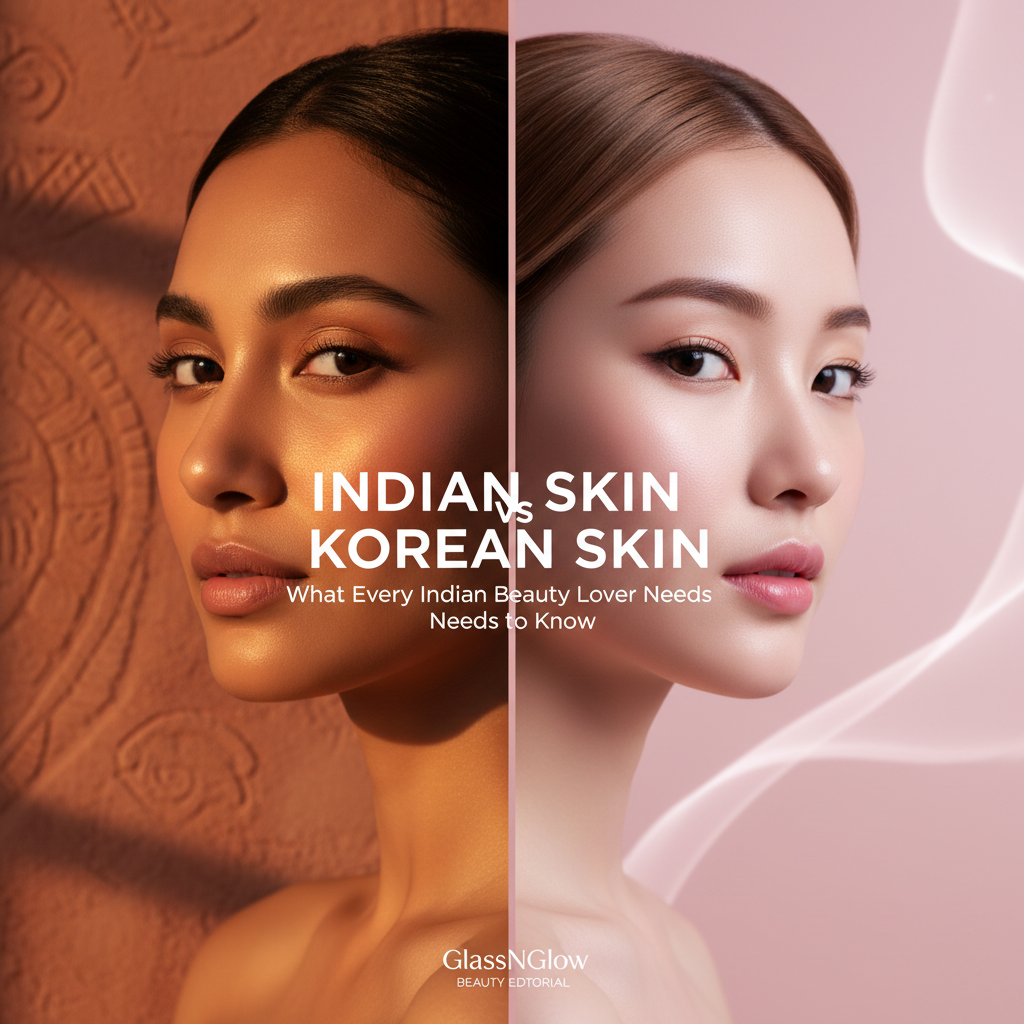
## The Big Question: Can Korean Skincare Actually Work for Indian Skin?
Korean skincare has taken the world — and India — by storm. From 10-step routines to glass skin goals, millions of Indians are turning to K-Beauty for their skincare answers. But here's the thing most beauty influencers won't tell you:
**Korean skin and Indian skin are fundamentally different.** And if you don't understand those differences, you could be spending thousands on products that are quietly working *against* your skin.
This isn't about K-Beauty being bad. It's about knowing your skin first.
---
## 1. Melanin & Pigmentation: The Root Difference
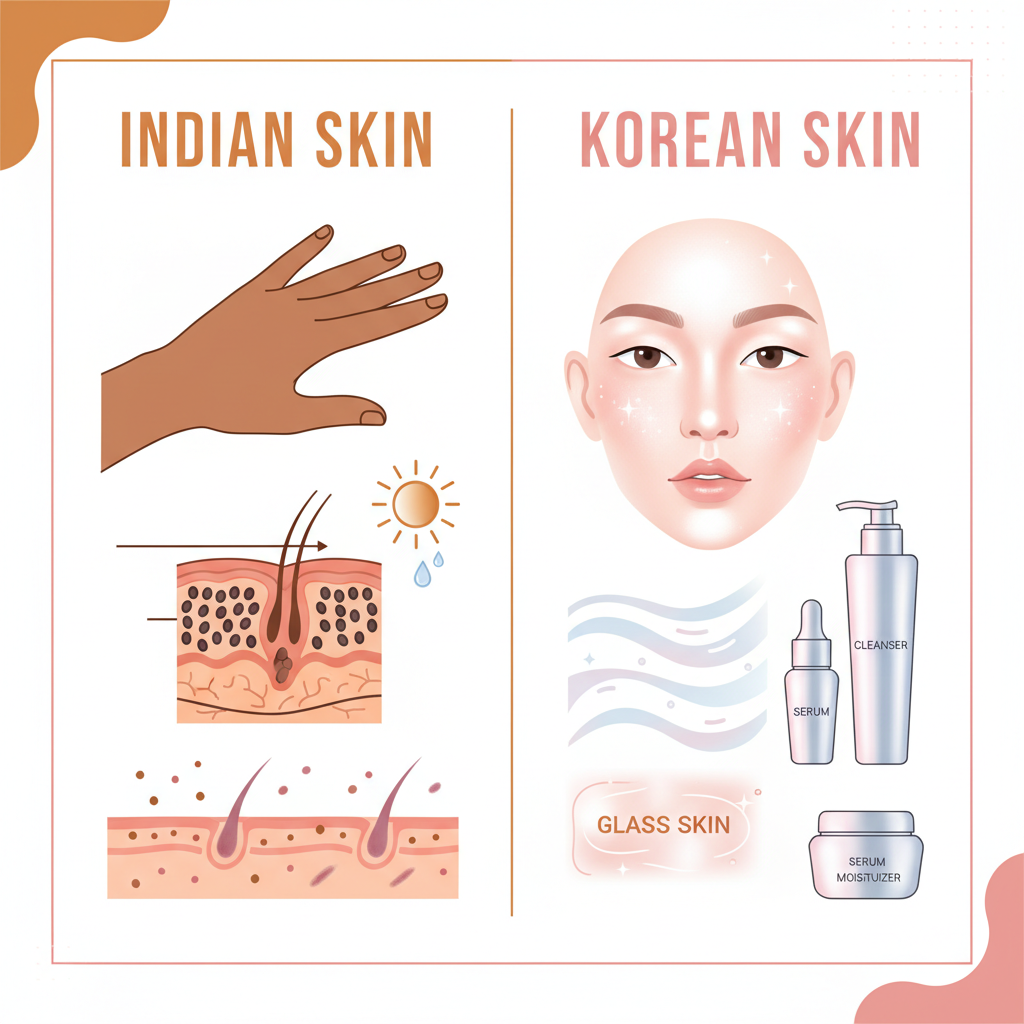
Indian skin falls higher on the Fitzpatrick scale (IV–VI), which means significantly **higher melanin concentration** compared to most Korean skin (II–IV). This melanin difference has major downstream effects:
### What Higher Melanin Means for Indian Skin:
✅ **Natural UV protection** — melanin does absorb UV rays, giving Indian skin some built-in defense
❌ **Higher PIH risk** — post-inflammatory hyperpigmentation is far more severe and longer-lasting
❌ **Melasma susceptibility** — hormonal + UV triggers hit harder on melanin-rich skin
❌ **Tanning** — Indian skin tans rapidly and deeply with even moderate sun exposure
### How Korean Skincare Addresses This (and Gets It Wrong for India)
Korean brightening products are typically formulated for **mild, surface-level discolouration** on lower-melanin skin. Ingredients like kojic acid at low concentrations, arbutin at 1%, or light niacinamide serums may not penetrate deep enough to address Indian skin's pigmentation.
**What Indian skin actually needs for pigmentation:**
- Tranexamic Acid (2–5%) — clinically proven for deep UV and hormonal pigmentation
- Alpha Arbutin (2%) — stabilised, higher concentration
- Niacinamide (10%) — reduces melanin transfer at higher doses
- Azelaic Acid (10–20%) — anti-inflammatory and brightening
- **Mandatory SPF 50+ PA++++** — no brightening ingredient works without daily SPF in India
---
## 2. Oiliness & Pore Activity: Why Your K-Beauty Moisturiser Is Ruining Your Skin
Indian skin is generally described by dermatologists as **thicker, more sebaceous, and more prone to enlarged pores** compared to Korean skin. This isn't a flaw — it's an adaptation to India's heat and humidity.
But it means K-Beauty's beloved rich moisturisers, sleeping masks, and occlusive balms can spell disaster:
| Skin Type | Korean Climate | Indian Climate |
|-----------|---------------|----------------|
| Oily / Combination | Heavy cream stays manageable | Heavy cream = clogged pores, breakouts |
| Dry | Rich cream gives relief | Rich cream still too heavy in humid months |
| Sensitive | Barrier repair cream soothes | Same cream may trap sweat & irritate |
### The Right Texture Formula for Indian Skin:
**Summer/Monsoon:** Water-based gel → essence → lightweight fluid SPF
**Winter (North India):** Add one layer of a ceramide emulsion on top
**Never in India:** Thick sleeping packs as a daily moisturiser, heavy shea/petrolatum balms year-round
---
## 3. Climate Exposure: The Factor Nobody Talks About
This is the single most overlooked difference. Skincare products are formulated and tested in specific climates. When you move them to a radically different environment, they behave differently.
**Korea:** Temperate — cold, dry winters; mild, low-humidity summers. Average UV Index: 4–7.
**India:** Ranges from tropical and coastal humid (Mumbai, Chennai) to dry-heat desert (Rajasthan) to humid subtropical (Kolkata) — all with UV Index of **9–12+ for most of the year**.
### Climate Effects on Common K-Beauty Products:
**Vitamin C Serums:** L-ascorbic acid oxidises rapidly above 30°C. In India's 38–42°C summers, an unprotected Vitamin C serum is likely **expired within weeks of opening**. Use stabilised derivatives: Ascorbyl Glucoside, 3-O-Ethyl Ascorbic Acid, or Sodium Ascorbyl Phosphate.
**Retinol:** Breaks down in UV light and humidity. In India, retinol must be a strict PM-only step, stored in a cool, dark location.
**Sheet Masks:** In India's humidity, a 20-minute sheet mask can cause **moisture overload and milia** for oily skin types. Limit to 2x per week maximum.
**SPF:** Korean sunscreens are often formulated for mild UV (SPF 30–35 is common). In India, **SPF 50+ PA++++** is the minimum. Full stop.
---
## 4. Primary Skincare Concerns: Different Goals, Different Routines
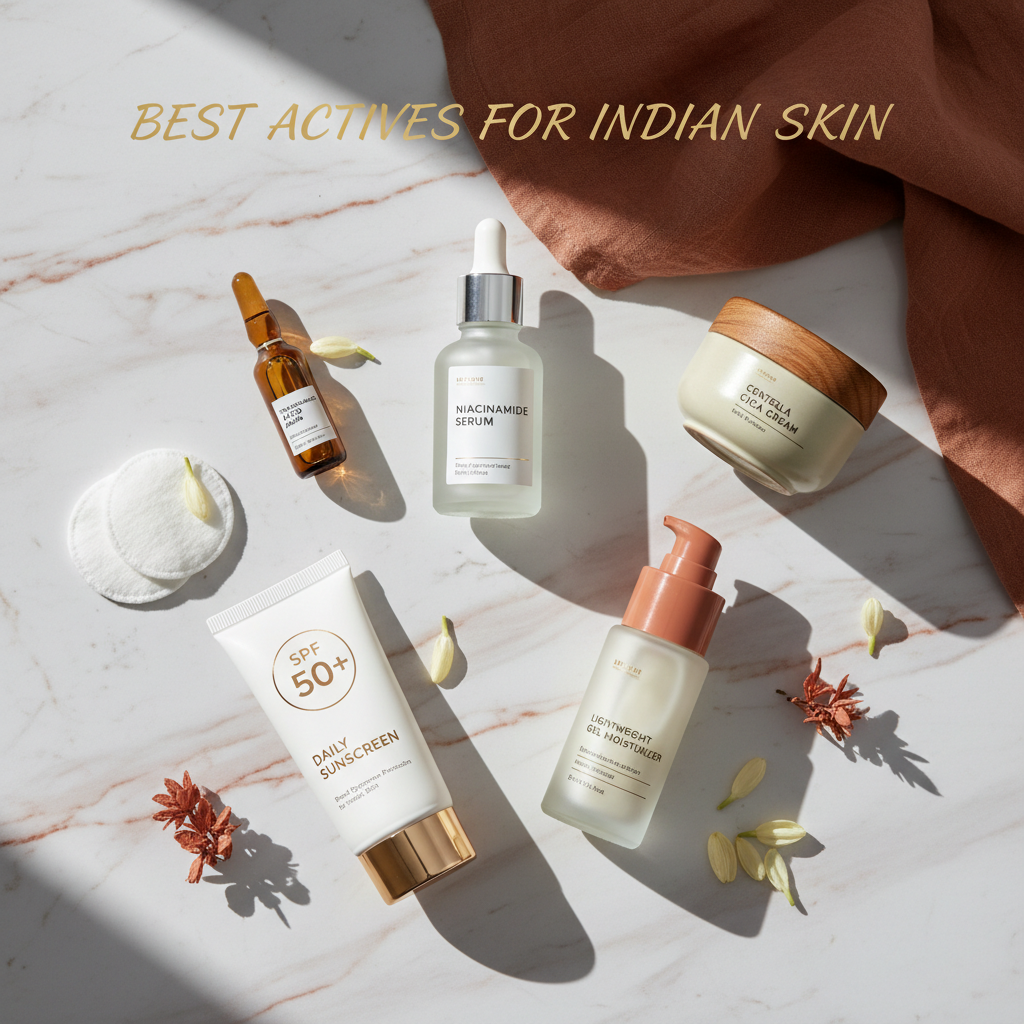
Korean skincare culture is built around **preventive care and hydration**. The famous glass skin look is about maximising moisture, minimising texture, and maintaining the skin barrier.
Indian skincare concerns are more **corrective and protective**:
| Concern | Prevalence in India | Best Approach |
|---------|--------------------|--------------|
| Hyperpigmentation & Dark Spots | Very High | Tranexamic Acid + Alpha Arbutin + SPF |
| Acne & Breakouts | High (especially 20s–30s) | BHA (Salicylic Acid) + Niacinamide |
| Sun Damage & Tanning | Very High | SPF 50+ PA++++ + antioxidant serum |
| Oily / Combination Skin | High | Lightweight gel routine |
| Sensitivity & Barrier Damage | High (often from harsh Indian products) | Centella, Cica, Panthenol |
| Dry Skin | Moderate (North India winters) | Ceramide + Hyaluronic Acid layering |
---
## 5. Product Texture Tolerance: What to Use vs What to Skip
The layered K-Beauty routine (toner → essence → serum → ampoule → moisturiser → sleeping mask) works beautifully in Korea's temperate, low-humidity climate. In India, it needs serious editing:
### ✅ K-Beauty Products That LOVE Indian Skin:
- **Low pH Gel Cleansers** (Centella, Mugwort, Green Tea)
- **Hyaluronic Acid Toners / Essences** — lightweight hydration
- **Snail Mucin Essence** — lighter than it sounds, excellent for repair
- **Niacinamide Serums** — universally excellent for Indian skin
- **Korean Sunscreens with PA++++** — often the most elegant textures available
- **BHA (Salicylic Acid) Toners** — excellent for acne-prone Indian skin
- **Centella / Cica Creams** — lightweight, anti-inflammatory, perfect for monsoon skin
### ❌ K-Beauty Products to Use With Caution in India:
- **Heavy Sleeping Packs** as daily moisturiser — too occlusive for Indian summers
- **Fragrance-heavy products** — heat amplifies fragrance, increases sensitisation risk
- **Rich Shea / Lanolin Moisturisers** — year-round use causes congestion
- **Daily exfoliating toners** — over-exfoliation is extremely common and damages Indian skin
- **Whitening products with high arbutin in unstable formulas** — watch for quality
---
## The Perfect India-Adapted K-Beauty Routine
### ☀️ Morning (5 Steps)
1. **Low-pH Gel Cleanser** — Centella or green tea base, no sulfates
2. **Hydrating Toner** — pat in, hyaluronic acid or beta-glucan
3. **Vitamin C Serum (stabilised)** — Ascorbyl Glucoside or 3-O-Ethyl Ascorbic Acid
4. **Lightweight Gel Moisturiser** — ceramides, no heavy occlusives
5. **SPF 50+ PA++++** — Korean hybrid formulas are excellent
### 🌙 Night (5 Steps)
1. **Oil Cleanser** — Squalane or Rice Bran oil base
2. **Gel/Foam Cleanser** — BHA (2%) if acne-prone
3. **Repair Essence** — Snail Mucin, PDRN, or Centella
4. **Active Serum** — Tranexamic Acid + Alpha Arbutin for pigmentation
5. **Ceramide Moisturiser** — Cica or Madecassoside base
---
## Our Verdict: K-Beauty for Indian Skin Works — When You Choose Wisely
The science and philosophy of Korean skincare — barrier health, gentle actives, consistent SPF, layered hydration — is **perfectly aligned with what Indian skin needs.** The mistake is copying the exact products and routines without adapting for India's unique skin and climate.
At GlassnGlow, every product we curate is selected with Indian skin in mind. We stock the Korean ingredients that love Indian skin — and skip the ones that don't.
**Shop our Indian skin-curated K-Beauty collection at [glassnglow.com](https://glassnglow.com/products)**
---
## Frequently Asked Questions
**Q: Is glass skin possible for Indian skin tones?**
Absolutely. Glass skin is about hydration, barrier health, and surface clarity — not skin colour. Indian skin achieves it with lightweight, climate-adapted K-Beauty routines.
**Q: Why does Korean skincare make my face oily in India?**
Occlusives in K-Beauty moisturisers trap sweat and sebum in India's humidity. Switch to water-based gel formulations without heavy occlusives.
**Q: Which Korean ingredients are best for Indian hyperpigmentation?**
Transexamic Acid, Alpha Arbutin, Niacinamide (10%), and Azelaic Acid — always paired with SPF 50+ PA++++.
**Q: Can K-Beauty cause acne on Indian skin?**
Yes — heavy oils and occlusives in humid Indian weather can cause comedonal and fungal acne. Always choose non-comedogenic, lightweight formulas.
**Q: How do I know if a Korean product is authentic in India?**
Buy only from authorised retailers. Red flags: price 50%+ below retail, missing Korean INCI list, packaging inconsistencies, no clear returns policy.