Glass Skin, Indian Reality: The Complete Guide to K-Beauty That Actually Works for Indian Skin
K-Beauty
## The Glass Skin Dream vs. The Indian Reality
Every Indian skincare lover has felt it — the excitement of unboxing a 10-step Korean skincare haul, the hope of waking up with translucent, poreless *glass skin*... and then the disappointment of waking up instead with **clogged pores, greasy shine, and new breakouts**.
You're not doing it wrong. The products are doing it wrong — *for your skin, in your climate.*
This guide breaks down exactly **why K-Beauty fails Indian skin**, what the science says, and how to rebuild a routine that delivers real glass skin results in India's heat, humidity, and sun.
---
## Why India and Korea Are Skincare Worlds Apart

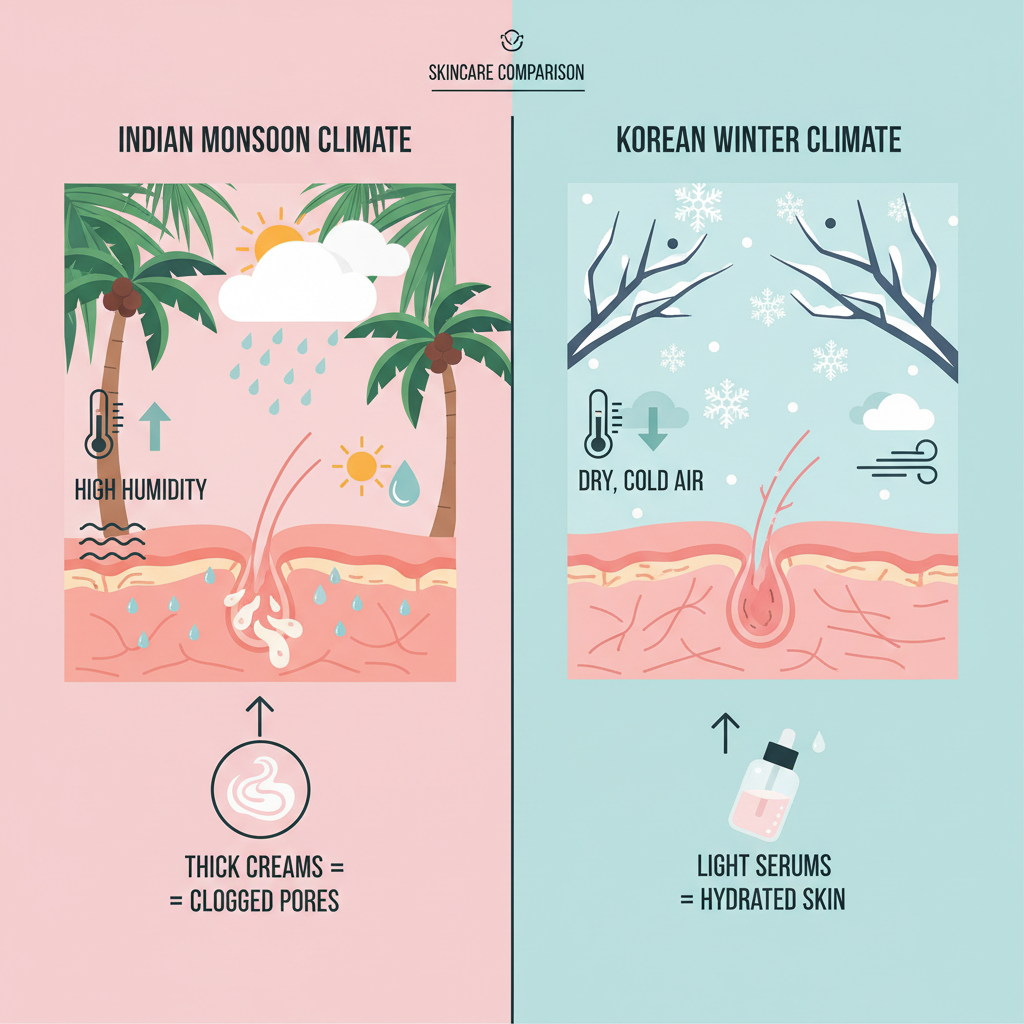
The core problem is **climate mismatch**. K-Beauty was developed and tested for Korea's climate — cold, dry winters and mild, low-humidity summers. Indian skin lives in almost the opposite conditions:
| Factor | Korea | India |
|--------|-------|-------|
| Average Humidity | 40–60% | 70–90% |
| UV Index | 3–7 | 9–12 |
| Skin Melanin | Lower (Fitzpatrick I–III) | Higher (Fitzpatrick IV–VI) |
| Pollution Level | Moderate | Very High (metro cities) |
| Hard Water | Less common | Very common |
Every single factor in this table changes how a skincare product performs on your skin. A moisturiser that "locks in hydration" in Seoul literally **traps sweat and sebum** in Chennai.
---
## Pain Point #1: The Humidity Trap — Why K-Beauty Makes Indian Skin Greasy
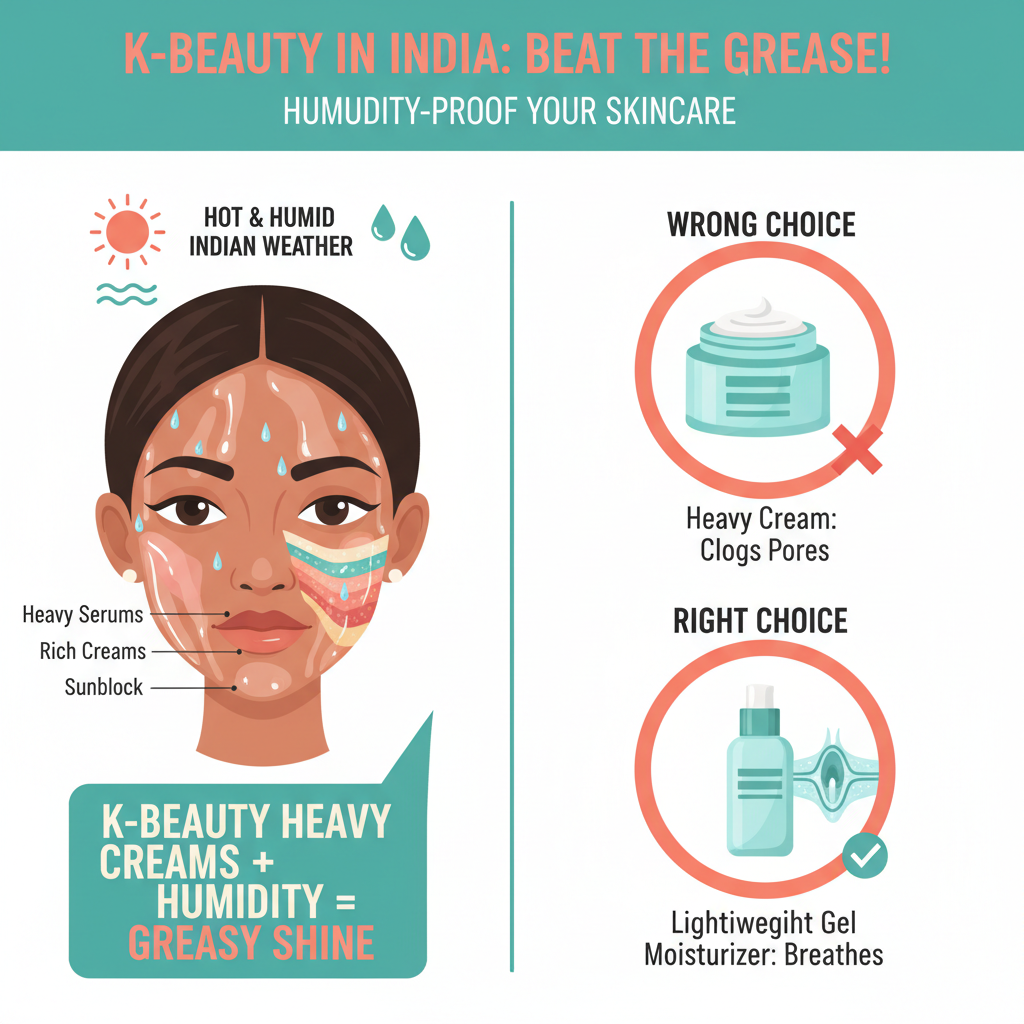
Korean winters are brutal. So K-Beauty formulations include **occlusives** — ingredients like petrolatum, dimethicone, shea butter, and lanolin — that form a physical seal over the skin to prevent moisture loss in dry air.
In India's 80–90% monsoon humidity, this backfires catastrophically:
- Your skin is **already retaining moisture** from the air (hygroscopic effect)
- The occlusive layer **traps sweat, sebum, and pollution particles** underneath
- This creates a **microbiome imbalance** in your pores
- Result: **Comedones, fungal acne, and what Indians call "monsoon breakouts"**
### The Fix: Ditch Heavy Occlusives, Embrace Humectants
For Indian humidity, your moisturiser should be a **humectant-forward, occlusive-light** formula:
✅ **Use:** Hyaluronic acid gel, beta-glucan essence, snail mucin (it's lighter than it sounds!), niacinamide serum
❌ **Avoid:** Heavy shea butter creams, thick balms, occlusive sleeping masks in monsoon months
> **Quick test:** Apply your moisturiser and wait 10 minutes. If your skin feels sticky or shiny — it's too heavy for India. It should feel like your skin drank water, not like it's wrapped in cling film.
---
## Pain Point #2: How Korean Products Damage Indian Skin
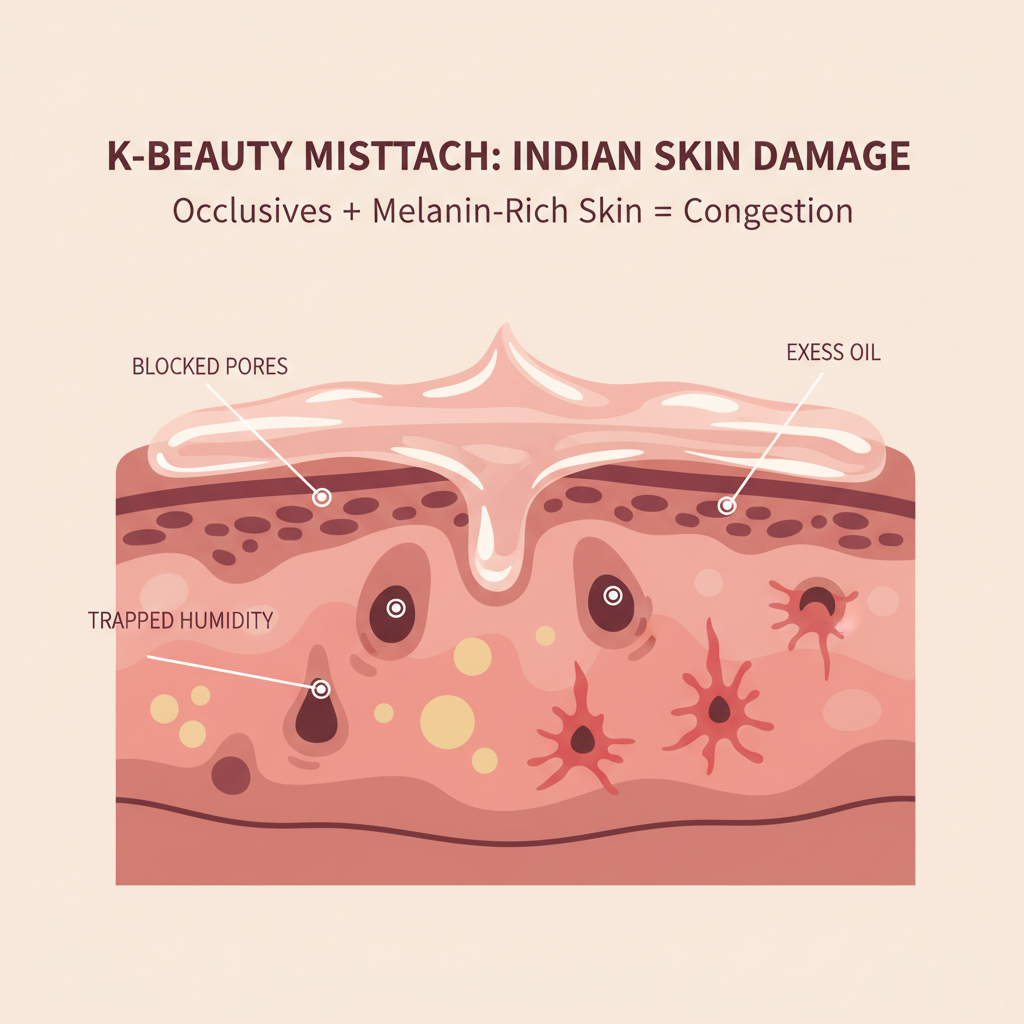
It's not just the grease. Using the wrong K-Beauty products can cause **real, lasting damage** to Indian skin:
### 1. Skin Barrier Disruption from Over-Exfoliation
K-Beauty popularised **daily exfoliation** — AHAs, BHAs, exfoliating toners used every day. For dry Korean skin in winter, this helps. For already-stressed Indian skin dealing with UV damage, pollution, and hard water? **It strips the barrier bare.**
A damaged skin barrier in India means:
- Increased trans-epidermal water loss (TEWL)
- Heightened sensitivity to pollutants
- **Post-inflammatory hyperpigmentation (PIH)** that takes months to fade on melanin-rich skin
### 2. Fragrance Sensitivity in Indian Climate
Many Korean skincare products contain **high fragrance loads** — lovely rose water, citrus extracts, floral essences. Heat amplifies fragrance molecules. In India's heat, fragranced products are **far more likely to cause contact dermatitis** and sensitisation than in Korea's cooler climate.
### 3. Vitamin C Oxidation in Indian Heat
L-Ascorbic acid (pure Vitamin C) is unstable. In Indian temperatures of 35–42°C, an unformulated or poorly packaged Vitamin C serum **oxidises rapidly**, turning orange and producing free radicals — the *exact opposite* of what it's supposed to do.
> **The fix:** Use stabilised Vitamin C derivatives — **Ascorbyl Glucoside or 3-O-Ethyl Ascorbic Acid** — which are heat-stable and gentler on Indian skin.
---
## Pain Point #3: The Deep Pigmentation Problem
Standard K-Beauty brightening products are formulated for mild hyperpigmentation on lower-melanin Korean skin. **Indian skin's hyperpigmentation is a different beast entirely:**
- Deeper melanin deposition in lower skin layers
- Triggered by UV rays that are **2–3x more intense** than in Korea
- Compounded by **hormonal factors** (melasma is extremely common in India)
- Hard water mineral deposits worsen uneven tone over time
### India-Effective Brightening Ingredients:
| Ingredient | Why It Works for India | Usage |
|-----------|----------------------|-------|
| **Tranexamic Acid** | Targets deep UV-triggered PIH | 2–5%, PM |
| **Alpha Arbutin** | Gentle melanin inhibitor, stable in heat | 2%, AM/PM |
| **Niacinamide** | Reduces melanin transfer + sebum | 5–10%, AM/PM |
| **Kojic Acid** | Surface brightening | 1–2%, PM only |
| **Azelaic Acid** | Anti-inflammatory + brightening | 10–20%, PM |
---
## The India-Adapted K-Beauty Routine
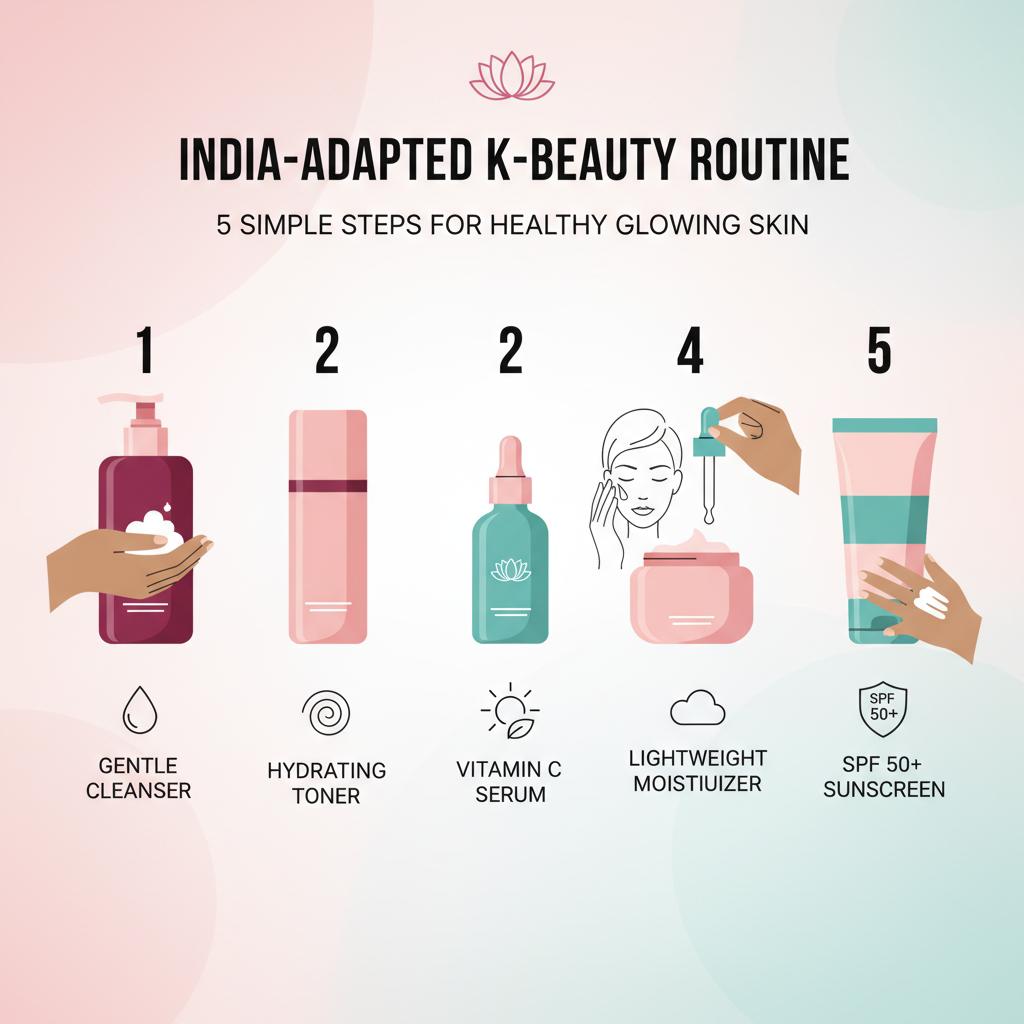
### ☀️ Morning Routine (5 Steps)
**Step 1 — Low-pH Gel Cleanser** *(Centella Asiatica, no fragrance)*
Low pH (4.5–5.5) cleanses without disrupting your skin's acid mantle. Avoid foamy cleansers with sulfates — they strip Indian skin too aggressively.
**Step 2 — Hydrating Toner / Essence** *(Hyaluronic Acid, Beta-Glucan)*
Pat in with hands — no cotton pads. This is your base hydration layer.
**Step 3 — Antioxidant Serum** *(Stabilised Vitamin C + Niacinamide)*
Apply before SPF to neutralise UV-generated free radicals.
**Step 4 — Lightweight Gel Moisturiser** *(Ceramides + Peptides, no heavy occlusives)*
Should absorb fully in under 60 seconds.
**Step 5 — SPF 50+ PA++++** *(Non-negotiable!)*
Physical (zinc oxide/titanium dioxide) or hybrid SPF. Reapply every 2–3 hours outdoors.
### 🌙 Night Routine (5 Steps)
**Step 1 — Oil Cleanser** *(Rice Bran or Squalane base)*
Removes SPF and pollution without stripping.
**Step 2 — Gel/Foam Second Cleanser** *(BHA if acne-prone, low pH)*
**Step 3 — Treatment Essence** *(Snail Mucin / PDRN for repair)*
**Step 4 — Active Serum** *(Tranexamic Acid + Alpha Arbutin for pigmentation)*
**Step 5 — Barrier Repair Moisturiser** *(Cica / Centella Asiatica, Madecassoside)*
---
## The Authenticity Problem: India's Fake K-Beauty Crisis
With Indian K-Beauty market growing at **30% YoY**, counterfeit products have flooded grey-market channels. The problem is more serious than a wasted purchase:
- Fake products often contain **undisclosed chemicals** that cause severe reactions on Indian skin
- pH may be completely wrong, causing chemical burns
- No CDSCO compliance — unregulated for Indian safety standards
### Red Flags of Fake K-Beauty in India:
🚩 Price is 50–70% below brand's official retail
🚩 No bilingual (Korean + English) INCI ingredient list
🚩 Packaging fonts, shade or logo placement looks slightly off
🚩 Seller has no clear returns or authenticity guarantee
🚩 Product smells stronger/different than reviews describe
---
## Frequently Asked Questions
**Q: Why does Korean skincare make my face so oily in India?**
Because K-Beauty moisturisers use occlusives designed for dry Korean winters. In India's humidity, they trap sweat and sebum, creating a greasy film. Switch to water-based gel formulations.
**Q: Can Korean products cause acne on Indian skin?**
Yes — specifically "fungal acne" (Malassezia folliculitis) from heavy oils and occlusives in humid Indian conditions, and comedonal acne from pore-clogging ingredients. Look for "non-comedogenic" labels.
**Q: Is glass skin possible for Indian skin tones?**
Absolutely. Glass skin is about hydration, barrier health, and surface clarity — not skin colour. Indian skin can absolutely achieve it with the right lightweight, climate-adapted routine.
**Q: Which Korean sunscreen is best for Indian skin?**
Look for PA++++ rating (not just SPF). Sunscreens formulated in Japan/Korea for humid climates often work better than those for dry climates. Avoid sunscreens with alcohol as the second ingredient.
**Q: How long does it take to see results with K-Beauty in India?**
With the right climate-adapted routine: 2 weeks for texture improvement, 4–6 weeks for hydration balance, 8–12 weeks for visible brightening and pigmentation improvement.
---
## The GlassnGlow Promise
At **GlassnGlow**, we don't just import K-Beauty — we curate it for Indian skin and Indian climate. Every product on our platform is:
- ✅ **100% Authentic** — sourced directly, no grey market
- ✅ **Climate-tested** — reviewed for Indian humidity and UV conditions
- ✅ **CDSCO compliant** — safe for Indian regulatory standards
- ✅ **Dermatologist reviewed** — screened for common Indian skin concerns
**Stop guessing. Start glowing.**
👉 [Shop Climate-Adapted K-Beauty for Indian Skin](/kbeauty)
👉 [Use Our Free AI Skin Advisor](/skin-advisor)